

How can art education create an awareness of the vitality of the world? What role do artistic practice, aesthetic experience and exhibition education play at a time when our understanding of ‘nature’ is undergoing fundamental change?
The Museum Sinclair-Haus and the international network „Nature through Art“ invited to a public conference. The focus was on current approaches to art education that consider art and nature in tandem – at the intersection of aesthetics and ecology, art and the natural sciences, and emotion and knowledge. The programme included lectures, discussions and workshops. The e-book „Nature through Art“: Art Education for Ecological Awareness, which bringstogether the network’s key approaches and experiences, was also be presented.
Traditionally, nature has served as both a motif and a material for the arts. With the ‘ecological turn’ that began in the early 2000s, perspectives have shifted: Nature no longer appears as something antithetical to humanity, but rather as a network of relationships in which humans are embedded as active and influential beings. This redefinition has far-reaching consequences for curatorial practice and art education.

Through lectures, discussions and hands-on workshops, various approaches to educational and outreach work were presented and discussed. The conference was the public part of a network meeting organised by Nature through Art and is aimed at art educators, curators, artists, academics and anyone else interested in this topic.
“Nature Through Art” is a peer education network connecting the education departments of Fondation Beyeler (Riehen/Basel), Gerðarsafn Museum (Kópavogur, Iceland), Louisiana Museum of Modern Art (Humlebæk, Denmark), Moderna Museet Malmö (Sweden), Moderna Museet Stockholm (Sweden), and Museum Sinclair-Haus (Bad Homburg), fostering exchange on methods, discourses, and perspectives in art education in which nature is understood as an active field of relations, knowledge, and perception.
Conference Programme, 10 June 2026
• Welcome and introduction, Kathrin Meyer (Director of the Museum Sinclair-Haus) and Kristine Preuß (Head of art education at the Museum Sinclair-Haus)
• Cultural Education in the Anthropocene, lecture by Nicola Lepp, Professor of Culture and Education in the Cultural Work Programme, Potsdam University of Applied Sciences
• Why go to a museum when you could go to the forest?, Estelle Zhong Mengual (art historian, Sciences Po Paris) in conversation with Sinan von Stietencron (StiftungKunst und Natur [Art and Nature Foundation])
• Launch of the new e-book by the Nature through Art network with representatives from the art education departments of Moderna Museet Malmö (Sweden), ModernaMuseet Stockholm (Sweden), Garðasafn Museum (Iceland), Louisiana Museum of Modern Art (Denmark), Fondation Beyeler (Switzerland) and Museum Sinclair-Haus(Germany).
Workshops
• In Togetherness: Encountering nature becomes art. Workshop led by Karin Bergdolt(artist and art educator)
• Deep Listening Movement: Methodology for artistic environmental education. Workshop led by Anno Bolender (dance artist and educator)
• The Object is Present: Aesthetic research in the context of waste collection as a practice of radical attentiveness. Workshop led by Astrid Lembcke-Thiel (independent curator for artistic processes and research-based artist)
• Meadowing: Collective research on coexistence. Workshop by Sina Ribak (researcher in ecology and art)

The Museum Sinclair-Haus, run by the Art and Nature Foundation (Stiftung Kunst und Natur), is the only art museum in Germany with a thematic focus on contemporary art and nature. Its environmentally conscious exhibitions and art education programmes explore the interrelationships between different living beings, raising awareness of the network of connections within the non-human world and humanity’s role within it. People of all ages are encouraged to experience the vitality of the world in a diverse ways.
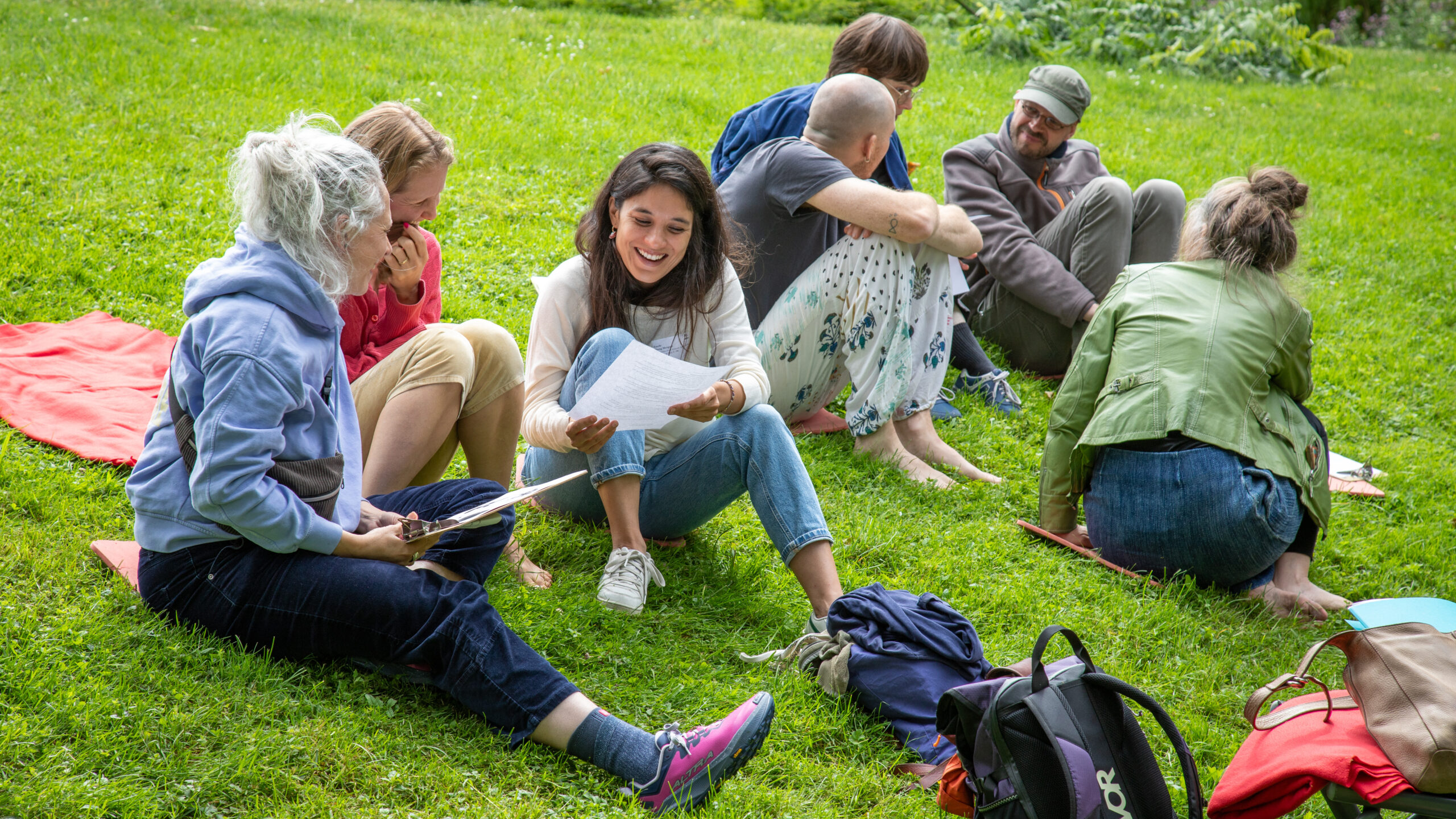
Participants experienced a sense of self-efficacy through artistic and creative processes – such as working with their hands, exploring their surroundings, engaging all their senses, and sharing their experiences. Art education opens up spaces of possibility and resonance in which one’s relationships with the living world can be explored and experienced. Artistic practice fosters imagination and creativity and helps us envision alternative futures. Through collective thinking and experimentation, these future scenarios can become tangible and conceivable.
The conference addressed the key questions of art education at the Museum Sinclair-Haus:
How can we use cultural and art education to establish relationships with—and develop new ways of connecting to—plants, animals, fungi, the soil and the natural cycles of life? How can we create opportunities to experience the vitality of our surroundings?
Who was taking part?
Art educators, curators, artists, academics and anyone with an interest in art and nature.
With international guests from the Nature through Art network, comprising representatives from the education departments of Moderna Museet Malmö (Sweden), Moderna MuseetStockholm (Sweden), Garðasafn Museum (Iceland), Louisiana Museum of Modern Art (Denmark) and Fondation Beyeler (Switzerland).
Cost: Participation in the conference was free of charge; registration was required.
Venue: Bad Homburg, hall of St. Marienkirche, Dorotheenstr. 13, 61348 Bad Homburg.